
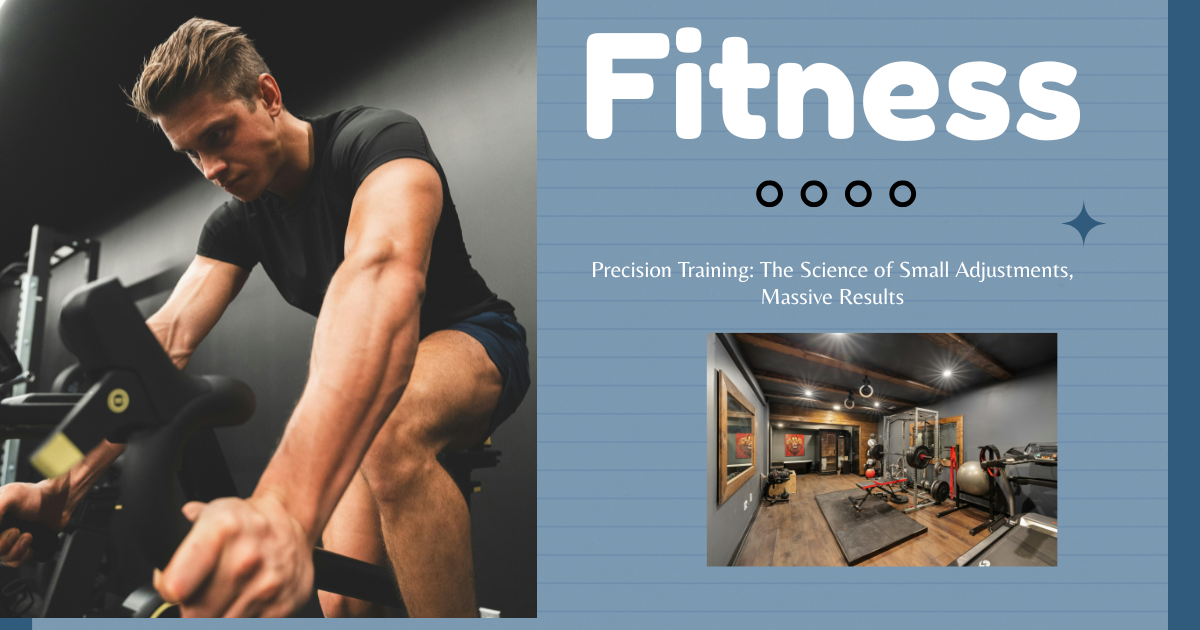
You are not lazy. You come to the gym four to five days a week. Grind out workouts when you feel like being on the couch. You keep a record of workouts in a notebook or an app and have used the fads — the ones with flashy titles and the assertion that change can happen in eight weeks. And it worked for some time. You saw that progress, and the dresses do not fit. The weights on the bar were increased.
And then something happened. However, your progress started to slow. You put on more sets, but nothing changed. You stayed longer, but the scale refused to move, and you came out of the gym tired but unchanged. Here is the plateau. This is not a weakness at all. It is an indication of full adaptation of your body to your present training stimulus. The issue is not your effort anymore. You are not precise enough.
What Precision Training Is (and is not)
In easy words, precision training is the conscious manipulation of the training factors to generate a predictable physiological response. In simple words, you do just what your body requires at this point to be able to move in the right direction towards your goal.
What precision training would look like in practice: You enter the gym knowing what weight you are going to lift, how many reps you will do, how much you will rest, and at what speed you will push the bar. There is a goal of bar speed. You are aware of your RIR in each set. And even before you start, you have to check your level of preparedness, sleep, soreness, and heart rate to see whether today is the day to push or to draw in. Everything is done by planning.
The five pillars of precision training.
There are five important variables you need to know and manage to train more precisely. Alter any of them, and the whole result of your session is altered. Get all five, and you can design anything you desire.
1. Intensity: How Heavy?
Intensity is expressed as a percentage of your one-rep maximum (1RM) weight that you are lifting. It is the most significant variable in deciding the types of muscle fibres and energy systems that are enlisted during a workout.
Precision training requires that you have the actual 1RM as accurately as possible. And since 1RM varies with time, you have to retest regularly or estimate 1RM by training by velocity each day.
2. Volume: How Much Work Are You Doing?
Volume is the amount of work you do and is expressed as sets x reps x load. The major factor causing hypertrophy is volume, and it is also the main cause of fatigue. In addition, a common error is adding volume when a stall is in progress. Increased frequency, more frequently, is a decrease in volume and an increase in intensity or a better quality of recovery. Precision training does not consider volume as an amount to maximise, but rather as a dial that should be turned tol high and to low.
3. Density: How Much Work Are You Completing in a Given Time?
Density is the amount of work you do in a specified period of time. Specifically, rest periods almost completely control it. A longer rest reduces density. Moreover, the suitable rest time is solely a matter of your objective. To achieve maximum strength and power, rest intervals between three and five minutes are required to completely regenerate phosphocreatine stores and enable the nervous system to restore itself.
Precision Training does not estimate rest periods. Also, you have a stopwatch. Every time.
4. Frequency: How Often?
The number of times per week you practise a particular movement pattern or set of muscles is known as frequency. Researchers have been training each muscle group once a week. In addition, research says that more frequent training of every muscle group, twice or four times per week, gives better results to most individuals and most people.
Precision Training is frequency-matched to your schedule, recovery ability, and training age. Novices usually begin with two or three sessions a week. Advanced lifters can train five to six days a week with volume and intensity that is well-controlled.
5. Pace: Slow or Fast?
Tempo is used to regulate the pace of every rep, the lowering or eccentric one. The eccentric stage, reducing the weight, involves greater muscle damage and is a strong motivator of hypertrophy. The concentric phase – hoisting the weight – is the phase in which you demonstrate your power and strength perfectly.
Specifically, training is a tempo-ascriptive training. Slow eccentric enhances muscle damage and growth. A concentric explosion enhances nerve drive and power. It is not precise to do the same tempo for all exercises, all sessions. It decreases the effectiveness.

The Data and Daily Preparedness.
Precision training depends on your condition. Your body varies daily depending on your sleep, stress, nutrition, and fatigue experienced in the preceding sessions. A programme that you wrote six weeks ago would not explain your poor sleep last night or why you have had a demanding week at work and are exhausted.
Performance metrics that are objective are also useful. Bar speed, measured with a tracker, will tell you whether you are really working as hard as you can or whether you are tired. Heart rate recovery, the rate at which your heart rate lowers after a set of exercises, shows your condition and how ready you are to begin the next set. Reps in reserve, which report truthfully, will give you an idea whether you are prescribing the correct load.
Top Training Errors
Even veteran lifters go wrong in attempting to be precise with training. The following are the most prevalent issues and their solutions.
- One common pitfall is to change too many variables simultaneously. One lifter wants to switch intensity, volume, rest times, and tempo within a week. In case of poor results, they could not determine which variable was the source of the poor results.
- Another mistake is neglecting recovery metrics. Lifters work hard each time, as they think that rest is a sign of weakness. Fatigue is a sign of hard work. It is a signal. When you are always sore, always tired, and your performance is declining with each session, then you are not being accurate. You are careless.
- Many lifters use an inappropriate rest period as a goal. Lifters who seek hypertrophy take a three-minute rest. Lifters who desire strength take half a minute.
- Another issue is not monitoring progress objectively. Failure to measure your RM1, your bar velocity, your volume load per month, or your body composition is flying blind. You cannot measure what you do not measure.
Conclusion
The fitness sector often suggests to you that the harder it is, the better. If you are not wearing yourself out, you are not doing better. Precision Training is opposed to this.
In some cases, the most productive exercise is lighter, slower, or shorter. At times, you should take a reload week. At times, you must cease three reps before failure. It is not its goal to self-destruct. Therefore, it is aimed at causing a certain adaptation and then walking out of the gym to allow recovery to take its course.
Train with precision. Measure everything. Progress always.
About the Author
The JustFitss editorial team is committed to publishing high-quality, research-backed content that empowers readers to live healthier lives. Furthermore, our articles are developed through careful analysis of peer-reviewed studies, guidance from reputable health organisations, and current fitness best practices. Every piece is fact-checked and regularly reviewed to maintain accuracy, relevance, and trustworthiness. While our content is educational in nature and not a substitute for professional medical advice, our goal is to provide practical, science-based information that supports informed health and fitness choices.
FAQS
1. How is precision training different from regular training?
Likewise, consistent training is more often based on effort and intuition, doing something difficult or something that you have always done. Precision training is data- and will-based. The variables, such as the rest periods before the rep speed, are selected to achieve a given result. Training consistently may make you feel drained. Precision training improves health and gives better results.
2. When should I re-test my one-rep max?
For most lifters, every six to eight weeks is enough. Working out more frequently than that will not allow your body to adjust. Frequent testing implies that you are training on old numbers. With velocity-based training, you can estimate your 1RM daily without maxing out.


1 Comment
atiya
Amzing information with authentic work