
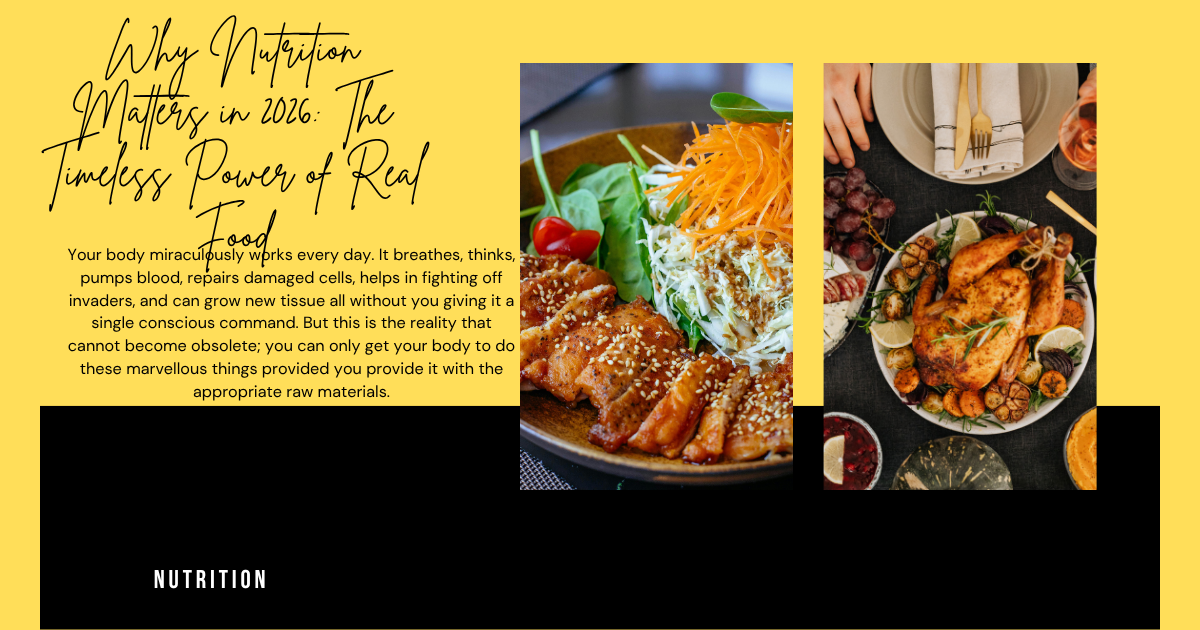
Your body miraculously works every day. It breathes, thinks, pumps blood, repairs damaged cells, helps in fighting off invaders, and can grow new tissue all without you giving it a single conscious command. But this is the reality that cannot become obsolete; you can only get your body to do these marvellous things provided you provide it with the appropriate raw materials.
Those are the raw materials that are referred to as nutrients. And the art of how to take them out of food is nutrition.
The future is in 2026, and we have fancy gadgets, artificial intelligence, and personalised tests. However, the principles of nutrition have remained the same. The six families of molecules your cells require are the same as those they required 10,000 years ago. This blog is not a med blog. And it is not a disease cure. It is concerning knowing what food really does to you—and why it is the most important investment you can make in your own energy, strength, and clarity.
What Does Nutrition Mean?
Nutrition is, at its simplest, studying how food transforms into you. Each time you bite, your digestive system breaks it down into microscopic building blocks. Those bricks at the time go through your blood to all parts of your body—to your brain, to your muscles, to your bones, and to your skin.
By giving quality building blocks, your body will construct a good structure. When you give blocks of poor quality or leave some out, your body has difficulties. It has no power to make something out of nothing.
Nutrients are divided into six groups that are important to all humans:
- Carbohydrates—The major source of fuel for your body.
- Proteins – The blocks on which to construct and repair any tissue.
- Fats—to store energy and produce hormones, as well as to give cell walls their structure.
- Vitamins: Tiny organic molecules that facilitate chemical reactions.
- Minerals—ionic elements that govern fluid level, nerve impulses, and bone resistance.
- Water—It is the solvent of all life processes, and it is everywhere.
Notice that none of these is pills. None are injections. They are all non-medical. They are food components, neither more nor less. When you consume a diverse, well-balanced diet of real foods, all six come into play.
The importance of nutrition at all ages.
The exact amounts of the nutrients vary with the progress of your age, although the meaning of ‘good nutrition’ does not diminish. We will consider three stages in life.
Childhood: Foundation Construction.
In the years between birth and the age of 18 years, the body of mature size is almost fully formed. Bones lengthen. Muscles attach. Millions of new connections are also made in the brain in a minute. All this does not go on without fuel. Protein is very important at such ages since children are building new tissues literally in a day. Less protein results in slow growth. Bones are tender and easily broken until adequate calcium and phosphorus (via dairy, leafy greens, or fortified food) are consumed. Lack of iron (in meat, beans, spinach, and so on) prevents blood from transporting necessary oxygen to the brain, so it is constantly tired and cannot concentrate at school.
- Carbohydrate substances are also vital to children, though they must include the complex carbohydrates of whole grains, vegetables, and fruits rather than sugar carbohydrates in cookies and soda. These give consistent, low-energy bursts of playground sprints, classroom concentration, and post-school activities.
Adulthood: Maintaining Performance
The nutrition objective of building ends when no more growth of your body takes place, and it becomes maintenance. The smallest tears that occur in your muscles every day require protein to be repaired. Carbohydrates are still required to supply your brain with glucose that can help you think. Fats are still required in your joints and hormones to operate normally. Poor nutrition manifests itself in a fast track in adulthood. Go without protein for a couple of days, and you’ll feel weak. Go without healthy fats for weeks, and your skin goes dry, your mood gets cranky, and your memory feels foggy. Exclude fibre (in vegetables, fruits, and whole grains), and digestion is slowed down.
- The greatest error of adults is to consume excessive amounts of bad things and fewer of the good things. Packaged snacks, sweetened beverages, white bread, frozen pizzas, and other processed foods offer calories (energy), but their actual nutrients are few. Consuming chips and soda, you can get 2000 calories of it and still feel hungry in terms of protein, vitamins, and minerals. And that is referred to as “hidden hunger”, and it is very rampant even in the rich countries.
Older Adulthood: Strength.
Once you turn 60, your body becomes less efficient in absorbing nutrients and building muscle. This does not imply that nutrition is not important. It implies that it gets more significant.
- In fact, protein needs in older adults are higher since older adults have muscle resistance to the message that protein conveys. Even eggs can be used to build muscle by a 25-year-old. A 70-year-old will require a bigger serving to have the same effect.
- Calcium and vitamin D are still important so as to make sure that bones are not made brittle. Fibre helps to keep the digestive system going. B vitamins (present in meat, eggs, and leafy greens) aid in nerve function and recollection.
One of the faults that many older adults commit is eating less due to their inactivity. Eat less often, however, and there is less ingestion of nutrients. It should not be that the amount of food should be reduced, but rather that food should be better. Lesser ratios of highly beneficial foods: a plateful portion of fish, a big fragment of steamed vegetables, a fruitful portion of bean soup on a whole-grain piece of bread, and a handful of nuts.
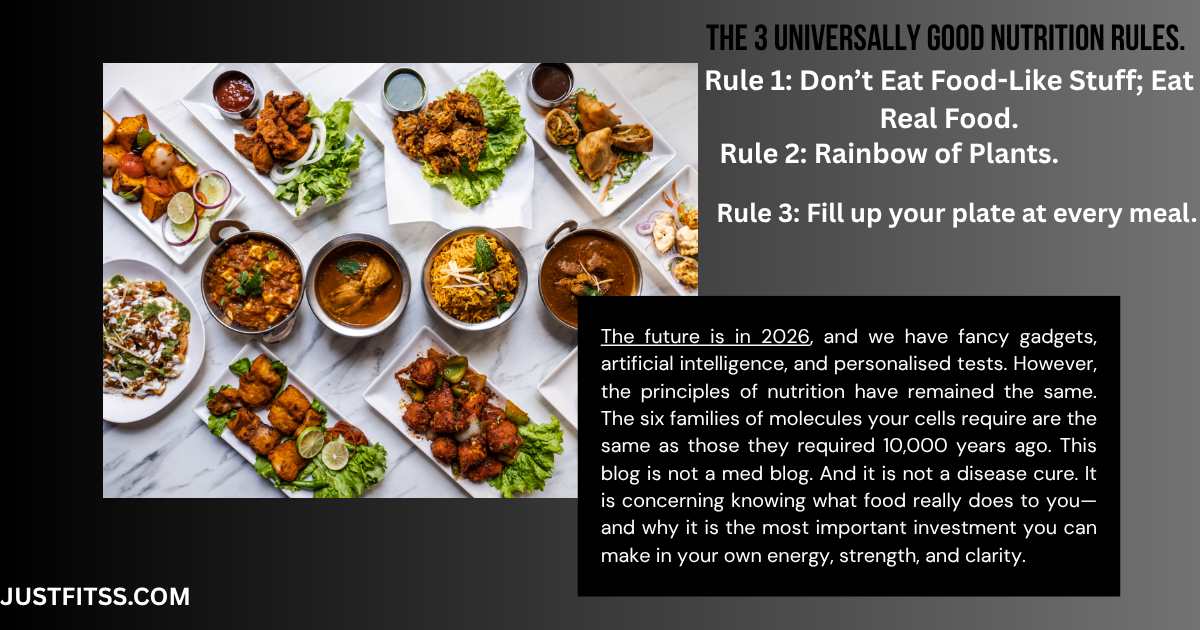
The 3 universally good nutrition rules.
These three rules will always get you wrong, no matter what your age is.
Rule 1: Don’t Eat Food-Like Stuff; Eat Real Food.
When a product contains an extensive, long list of ingredients comprising unfamiliar names, that is not food. Actual food is unadulterated: an apple. A chicken breast. One or two almonds. A bowl of oatmeal. These products do not require labelling on what they are.
In real food, the entire package gets to be in the form that it would have in nature. Because an orange does not contain vitamin C. It is also rich in fibre, potassium, flavonoids, and water—all of which are collaborative. One of the vitamin C pills will not be able to imitate such synergy.
Rule 2: Rainbow of Plants.
The plants of different colours are sources of various families of nutrients. Lycopene is found in tomatoes that are red in colour. Beta-carotene is in orange carrots. Dark green spinach will provide you with magnesium and vitamin K. Blueberries will provide you with anthocyanins.
These are names that you do not have to memorise. Simply have a lot of colours to eat. Work towards using at least five colours of fruits or vegetables daily. This is the only habit that you need to make sure to obtain a wide spectrum of vitamins, minerals, and protective compounds from.
Rule 3: Fill up your plate at every meal.
There are three things in a well-rounded meal:
- A protein source (meat, fish, eggs, beans, lentils, tofu, or dairy) and one of the sources of complex carbohydrates (rice, quinoa, oats, potatoes, whole-grain bread, or starchy vegetables)
- A fibre and micronutrient (non-starchy vegetable or fresh fruit) source.
- Eating and having all three on your plate makes you satisfied. Your strength remains constant for hours. You are not in need of snacks 30 minutes later. Don’t feel like anything but full.
The Bottom Line
Good nutrition is not that difficult, not even in 2026. Carbohydrates, proteins, fats, vitamins, minerals, and water are what your body requires. It requires them throughout all ages of their lives: the childhood stage, adulthood, and older adulthood. As you feed yourself with these nutrients in real and balanced food, your body will compensate you by giving you energy, strength, clarity of thought, and a stable mood. Every vegetable has no substitute in the form of a pill. None of the medical practices replaces a fish. No application can chew food. Good nutrition is just an ordinary act of picking actual food, consuming it in numerous hues, and balancing your plate. Those 3 things will see you feed your body that which it has been longing to receive for thousands of years.
There is no medicine. Stop eating. That is all that it takes to take care of yourself, one food after another.
FAQs
Q1: What can I do to determine whether I drink enough water?
You have clear signals from the body. The simplest technique: do a urine colour test, which means that you are well hydrated: pale yellow or straw-coloured. Dark amber or brown signifies that you have to take more water. So entirely clear, it could be that you are overhydrated (this is hardly ever possible, but it may leave minerals drained). This thirst also can be trusted truthfully—drink when you are thirsty. An average of 8 to 10 cups (2-2.5 litres) of fluid a day is a rough estimate; however, it depends on your size, activity, and weather. Food, especially soups, vegetables, and fruits, also provides you with water.
Q2: Is it true that I must not eat eggs due to cholesterol?
That is old-fashioned and has been fixed by nutrition science. The role of dietary cholesterol (the cholesterol that you consume in your foods, such as eggs) contributes very little to the level of cholesterol in the bloodstream of most individuals. In you, the huge amount of cholesterol in the body comes from your liver. Numerous randomised controlled trials on healthy individuals with no association between the use of eggs and heart disease have been carried out. Eggs are, in fact, some of the highest-nutrient foods.
1 Comment
atiya
“This is a well-articulated and insightful post. I appreciate how you’ve broken down complex ideas into actionable takeaways. The practical examples you included really strengthen the overall value for readers. Looking forward to more content like this—keep up the great work!”